
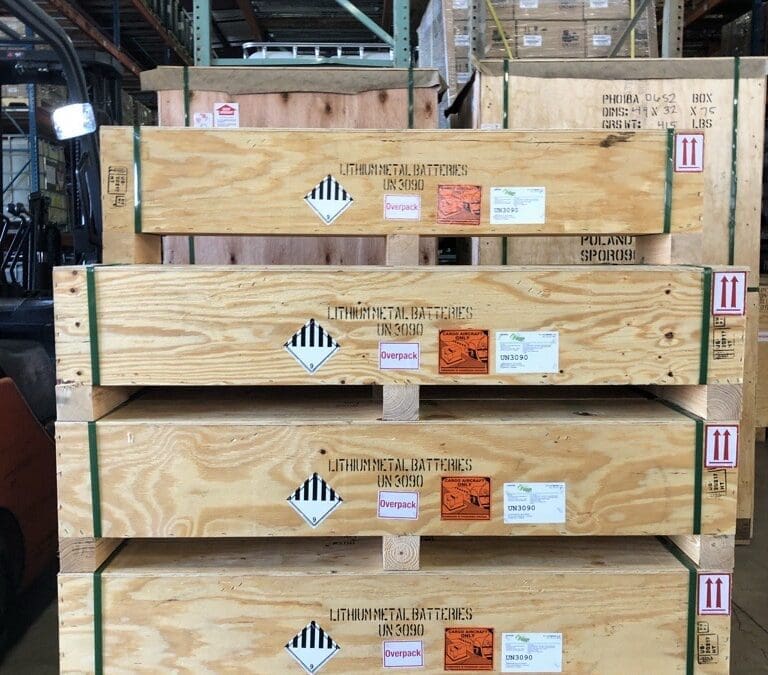
Georgia is home to some of the most advanced EV battery production facilities in the country, creating a growing demand for lithium battery shipping in Georgia. Cell plants run in Commerce, Bartow County, and Ellabell. In July, Hyundai and SK Battery opened a $5 billion plant northwest of Atlanta to make cells, while Rivian has its own $5 billion plant under construction.
Every one of these cell sites depends on an interconnected web of suppliers, test labs, equipment makers, and service companies. Lithium battery shipping in Georgia supports this EV supply chain by sending batteries to testing labs, prototypes to an engineering partner, replacement packs to a service center, or damaged units to a lithium battery recycler.
Lithium batteries are a Class 9 dangerous good. Meaning there are extra rules and precautions that must be followed to ship in compliance and safely. A mislabeled box can mean a rejected shipment, a civil penalty, or at worst, a fire in transit. This guide covers what moves through Georgia’s EV corridor, which rules apply, and how to package lithium batteries for shipment step by step.
Georgia EV battery corridor
Georgia is an EV hotspot and center of innovation. The corridor runs from northeast Georgia to the coast, with Atlanta at its center. Here are some of the sites driving battery shipping demand in 2026.
| Site | Location | What batteries/cells it produces |
|---|---|---|
| SK Battery America | Commerce, Jackson County | Lithium-ion cells for VW, Hyundai, and Kia models |
| Hyundai-SK On battery plant | Bartow County, northwest of Atlanta | Cells, up to 35 GWh per year |
| HL-GA Battery Company (Hyundai and LG Energy Solution) | Ellabell, Bryan County | Cells, 30 GWh per year; Hyundai Mobis assembles packs |
| Hyundai Motor Group Metaplant America | Ellabell, Bryan County | Hyundai, Kia, Genesis EVs and hybrids |
| Rivian | Stanton Springs North | R2 and R3 vehicles |
These are not all the companies that are shipping batteries in the corridor. They are the large drivers of demand in the area, and each one has dozens of contractors, suppliers, and logistics partners that ship lithium batteries at some point.
What types of lithium batteries move through the Georgia corridor?
Not every shipment in this corridor looks the same, and the regulations that apply depend heavily on what’s inside the box. Battery manufacturers, module assemblers, and vehicle plants in the corridor typically handle:
- Cells: Shipped on their own, these are individual lithium-ion cells that often move from cell plants to pack assemblers, then test labs and R&D teams. This falls under UN 3480.
- Modules and packs: These are groups of cells wired together; they are often extremely large and high in wattage, and packaging and carrier acceptance is more difficult for modules and packs.
- Batteries with or in equipment: These include test rigs and components that contain or come with a battery; they ship under UN 3481, while battery-powered vehicles ship under UN 3556.
- Prototype batteries: These batteries and cells are ones that have not completed the UN 38.3 testing; this is common in areas where there is a lot of research and development.
- Damaged, defective, or recalled batteries: Batteries that have failed inspection or are damaged have the highest risk and the strictest rules for shipping.
Each category may have a different UN number and requirements. A pallet of loose cells and a fully assembled EV battery pack are both “lithium batteries” on paper, but they’re worlds apart in how they must be packed and documented.
Lithium battery package requirements by mode
Under the different governing regulations, each mode of transportation has its own set of requirements for shipping. For example, many corridor shipments are multimodal, so they take a truck to Hartsfield-Jackson, then a flight, or a truck to the Port of Savannah, and then a vessel.
| Mode | Governing Rules |
|---|---|
| Ground | DOT/PHMSA, 49 CFR, mainly §173.185 |
| Air | IATA Dangerous Goods Regulations and ICAO Technical Instructions IATA Battery Guidance |
| Ocean | IMDG Code |
What changed in 2026?
On January 1, 2026, the 30% state-of-charge limit became mandatory for air shipments. It had already applied to batteries shipped alone (UN 3480). It now also covers batteries packed with equipment and vehicles with batteries over 100 Wh.
For corridor shippers, that means checking and documenting charge level before a battery goes to the airport, not after it gets rejected there.
Training is part of compliance
Anyone who classifies, packs, marks, labels, or signs for a lithium battery shipment must receive the training applicable to their assigned functions. Air shipments must meet the ICAO/IATA requirements.
How to package lithium batteries for shipment
These steps apply to standard, undamaged lithium-ion batteries only. Before attempting to package or ship lithium-ion batteries, consult a qualified professional to ensure all safety requirements are met. Lithium-ion batteries are classified as dangerous goods and require proper handling, packaging, and shipping procedures, which involve specific training and certifications.
- Classify the battery: Determine whether the battery is a lithium-ion battery or lithium metal, and whether it ships alone, with equipment, in equipment, or in a vehicle. You can find the watt-hour rating on the battery itself or its spec sheet.
- Get the UN 38.3 test summary: Production batteries must pass UN 38.3 testing, and shippers must be able to provide a test summary on request. Batteries that have not completed the testing may be shipped as a prototype or low-production, which has its own specific packaging and shipping requirements.
- Check the state of charge: For air shipments, confirm the state-of-charge requirements for that specific battery’s classification and packing instructions. Certain lithium-ion battery shipments are subject to the 30% state-of-charge limit requirements.
- Protect against short circuits: Prevent short circuits with non-conductive caps, tape, or individual inner packaging.
- Package the batteries to prevent shifting: Use a significant amount of inner packaging so batteries cannot shift, and so a device cannot accidentally switch on.
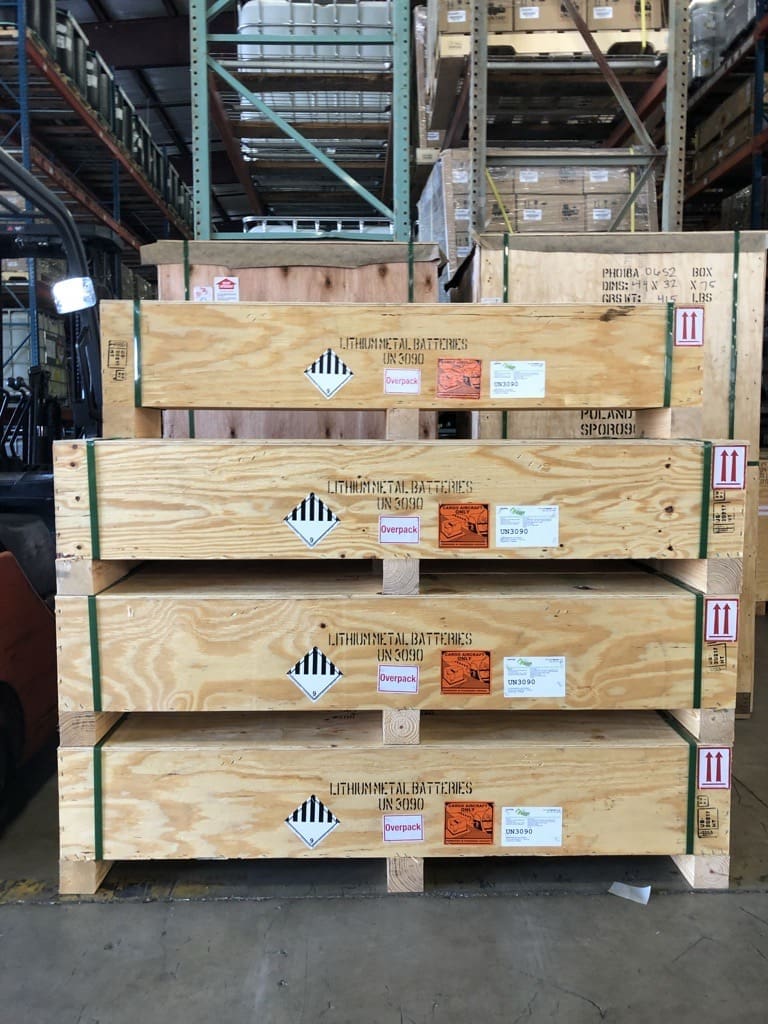
- Select the right outer packaging: Most regulated shipments require UN specification packaging that meets Packing Group II; larger batteries may qualify for packaging such as a custom crate under the rule for their mode of transport.
- Mark and label the package: Determine which hazard labels, lithium battery marks, UN identification numbers, and shipping descriptions are required for the shipment. Requirements vary based on classification and transport mode.
- Complete the paperwork: Prepare shipping papers for ground, a Shipper’s Declaration for Dangerous Goods by air, or a Dangerous Goods Declaration for ocean.
- Confirm carrier acceptance: Lastly, check with your carrier that they will accept your batteries; ground, ocean, and air carriers often add their own rules on top of the regulations.
Get lithium battery shipments packed and shipped right
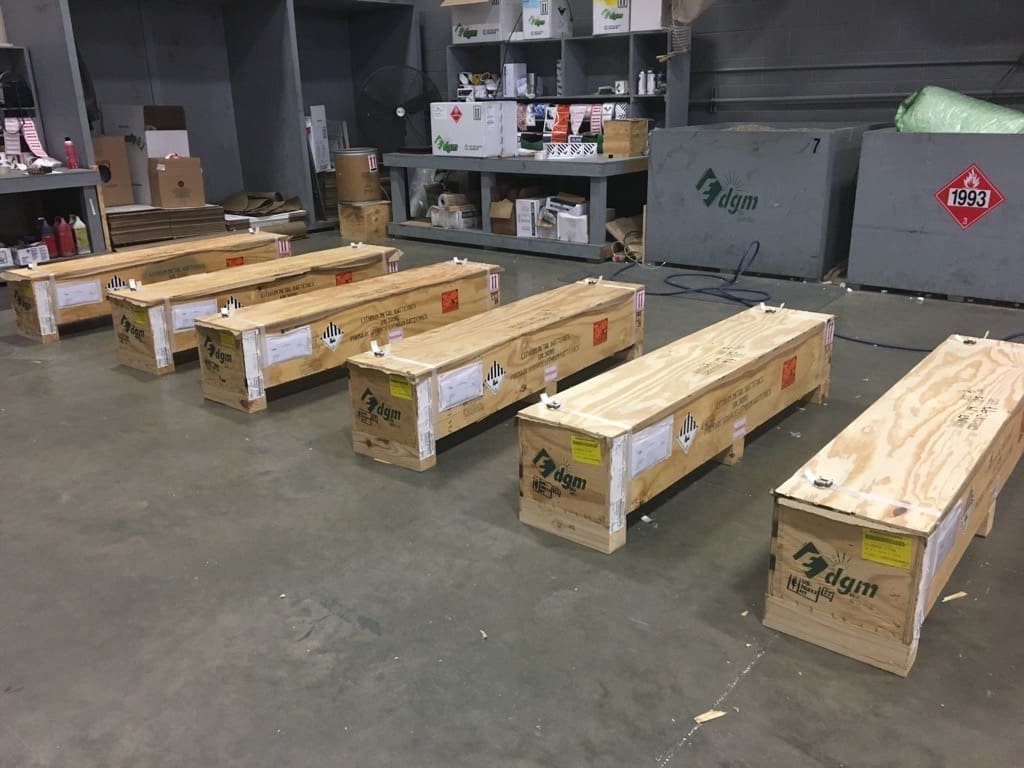
DGM USA specializes in dangerous goods packing, including the classification, marking, labeling, and documentation of lithium battery shipments required for air, ground, or sea transport. DGM’s Atlanta location, just two miles from Hartsfield-Jackson Atlanta International Airport, supports businesses across Georgia’s automotive and manufacturing sectors with compliant lithium battery packing and dangerous goods consulting.
If your business needs lithium battery shipping in Georgia, DGM USA ships lithium cells, modules, or packs anywhere near Georgia’s EV corridor. Contact DGM USA to talk through your packaging and compliance needs.

ABOUT THE AUTHOR
Erin Levey
Erin Levey writes about dangerous goods shipping, packaging, and compliance for DGM USA. Erin Levey is the Strategic Initiatives Manager at DGM USA, bringing 7 years of logistics experience and 2 years specializing in dangerous goods management. Her background also includes 11 years in training and education.
